
Why Public Spaces Matter More Than We Realize
Why Public Spaces Matter More Than We Realize
One social issue that often receives less attention than it deserves is the decline of meaningful public space. Public spaces include parks, libraries, sidewalks, plazas, community centers, and other shared environments where people can exist together without needing to spend money. These places may seem ordinary, but they play an essential role in social life. When public spaces are neglected, communities often become more isolated, unequal, and fragmented.
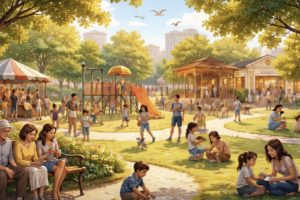
A healthy society needs places where different kinds of people can encounter one another naturally. In daily life, many environments are divided by age, income, occupation, or social group. Schools separate students from adults. Offices separate workers by profession. Private clubs, expensive cafes, and gated communities often limit who feels welcome. Public spaces are one of the few settings where people from different backgrounds can share the same environment. A park bench, a neighborhood library, or a public square may seem simple, but these places quietly support social connection and civic life.
Public spaces are especially important for people who do not have access to many private resources. A teenager who lives in a small apartment may rely on a library to study peacefully. An older adult who lives alone may depend on a nearby park for fresh air and human contact. Children need safe outdoor places to play and interact. Families may need community centers for programs, sports, or support services. When these spaces are missing, daily life becomes narrower and more stressful, especially for people with fewer economic advantages.
The decline of public space is tied to several modern trends. In some cities, overdevelopment has replaced open areas with commercial buildings and luxury housing. In other places, public spaces still exist but are poorly maintained, unsafe, or difficult to access. At the same time, more social life has moved indoors and online. People increasingly spend time in private spaces, on personal devices, or in places where participation depends on spending money. This can weaken the shared experiences that help communities feel connected.
There is also an important political dimension to public space. Public spaces are where people gather, speak, celebrate, protest, and observe one another as members of the same society. They are not only physical locations but also symbols of who belongs. If a city’s public areas are clean, welcoming, and accessible, they send the message that all residents matter. If they are neglected or designed mainly for surveillance, exclusion, or commercial profit, they send the opposite message.
Young people are especially affected by this issue. In many communities, teenagers are often treated as though they are welcome only in schools, homes, or commercial places. If they gather in public, they may be viewed with suspicion rather than recognized as part of community life. But young people also need places where they can socialize, move freely, and develop a sense of belonging. A society that offers young people no meaningful public space should not be surprised when isolation, boredom, and disconnection increase.
Protecting public space is therefore about more than urban design. It is about social well-being, fairness, and democratic life. Governments and communities should invest in parks, libraries, sidewalks, recreation areas, and other shared places that are safe, well-maintained, and open to everyone. These are not luxuries. They are part of the basic social infrastructure that allows people to live not only near one another, but with one another.
In the end, public spaces remind us that society is shared. They create room for ordinary human connection, and in doing so, they strengthen the fabric of community in ways that are easy to overlook but difficult to replace.
HAODE (YUKI) CHEN